

Appearance
Intel Analysis — Methodology
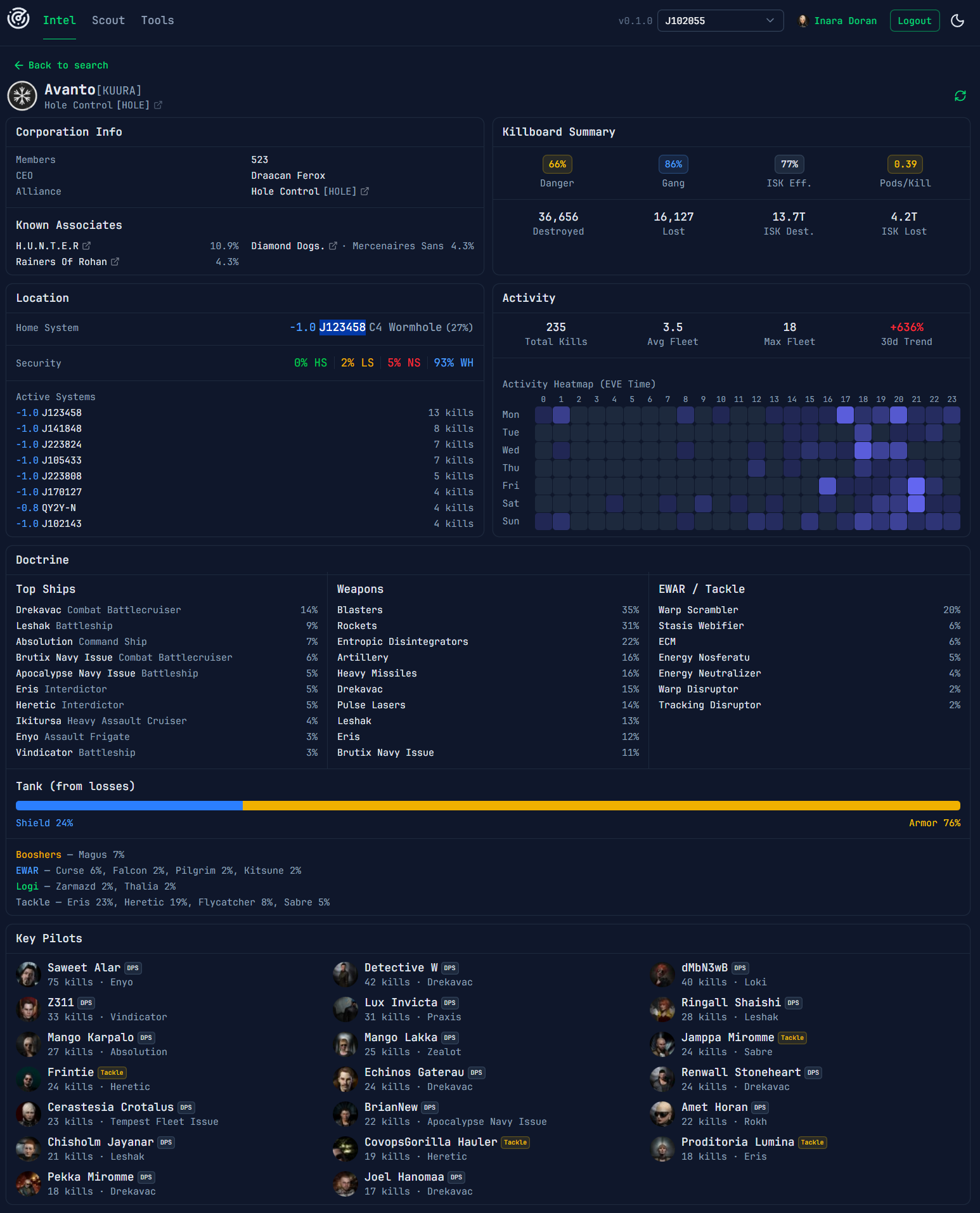
This document explains the reasoning behind each value calculated in the corp intel tool. All analysis is derived from killmail data fetched from zKillboard (kill references) and ESI (full killmail details).
Kill Filters
Two filters are applied throughout the analysis to ensure data quality:
PvP Kill (isPvpKill)
A killmail counts as PvP if the victim has a character_id (i.e., not an NPC structure or POS) and the victim's ship is not a padding type. This filter is used for activity, associates, and general kill counts.
Fleet PvP Kill (isFleetPvpKill)
A stricter filter requiring PvP kill status AND at least 2 corp members among the attackers. This removes solo kills and ganks from fleet-oriented analysis (location, doctrine, force multipliers). The reasoning: solo kills don't reveal fleet composition or staging patterns.
Padding Kills
Capsules, shuttles, and rookie ships are excluded from most analysis. These inflate kill counts without reflecting real PvP capability. They are tracked separately as paddingKills for the pod ratio metric.
Killboard Summary
Values in this section come directly from zKillboard stats, not from killmail analysis.
Danger Ratio
zKill's own metric (0–100). Measures how dangerous a corp is based on kill/loss patterns. Higher values mean more dangerous. Displayed with color coding: >=80 red, >=50 yellow, <50 green.
Gang Ratio
zKill's metric (0–100). Percentage of kills that involve multiple pilots. A high gang ratio (>70%) indicates the corp primarily operates in fleets rather than solo.
ISK Efficiency
iskDestroyed / (iskDestroyed + iskLost) * 100. A standard EVE metric — how much of the total ISK exchanged in combat did this corp destroy vs lose. 50% is break-even, >50% is ISK-positive.
Ships Destroyed / Lost
Raw counts from zKill stats. Provides a quick sense of scale and kill/death ratio.
Pods per Kill
paddingKills / totalPvpKills. Measures how aggressively the corp pods victims. A high ratio (>0.5) suggests they routinely kill pods after ships, which can indicate gatecamps, wormhole evictions, or disciplined cleanup. Color coded: >=0.5 red, >=0.2 yellow.
Location
All location analysis uses the fleet PvP kill filter (2+ corp members on kill) to focus on organized activity rather than solo roams.
Home System
Determined by a composite score combining two factors:
- Kill share —
system kills / total kills— how concentrated their activity is in this system - Weekly regularity —
weeks active in system / total weeks with any activity— how consistently they return to this system
The final score is regularity * 0.7 + killShare * 0.3, weighted heavily toward regularity. The system with the highest score is identified as the likely home. The confidence percentage is this score × 100.
Why weight regularity higher? Kill share alone would pick a system where they had one big fight. Regularity captures consistent presence — especially important for wormhole corps, whose kills spread across many J-systems while their staging hole appears week after week with fewer kills per session.
Active Systems
Top 10 systems by kill count (fleet PvP kills only), sorted descending. Each entry includes system name, security status, region, and kill count.
Security Breakdown
Kills bucketed by security class of the solar system:
- Highsec — security status >= 0.45
- Lowsec — security status >= 0.05 and < 0.45
- Nullsec — security status >= -0.5 and < 0.05
- Wormhole — security status < -0.5 (wormhole systems have sec status of -1 in the SDE)
Displayed as percentages of total fleet PvP kills. Reveals the corp's preferred space — a corp with 90% wormhole kills operates very differently from one with 90% nullsec.
Activity
Activity analysis uses the broader PvP kill filter (includes solo) since we want to capture all combat timing patterns.
Heatmap
A 7×24 grid (day of week × hour of day, UTC/EVE Time). Each cell counts PvP kills where the corp was involved (as attacker or victim). Cells are colored with indigo at proportional opacity — 0 kills is neutral, the maximum value is fully saturated, and everything in between scales linearly. Reveals when the corp is active — useful for planning engagements or avoidance.
Peak Hours
Hours where kill count reaches >=70% of the maximum hourly total. This threshold captures the core active window rather than just the single busiest hour.
Peak Days
Same 70% threshold applied to daily totals. Identifies which days of the week the corp is most active.
Fleet Size (Average / Max)
Estimated by grouping kills into engagements:
- Sort all kills (where corp is attacking) by timestamp
- Kills in the same system within a 30-minute sliding window are grouped into one engagement
- For each engagement, count unique corp member character IDs across all kills
- Average and maximum of these counts give fleet size estimates
Why 30 minutes? EVE fleet fights typically involve multiple kills over 10–30 minutes. A 30-minute window captures sustained engagements without merging separate fights.
Limitation: This is a lower bound. Pilots who don't get on any killmail (e.g., logistics, scouts, boosters who don't apply damage) are invisible to this analysis.
30-Day Trend
((kills in last 30 days - kills in prior 30 days) / kills in prior 30 days) * 100. A simple percentage change showing whether the corp's activity is increasing or decreasing. Positive = more active recently, negative = declining.
Doctrine
Doctrine analysis uses the fleet PvP kill filter to focus on organized fleet compositions.
Top Ships
Counts how many times each ship type appears among corp attackers on fleet kills. Sorted by count, displayed with percentage of total ship appearances. Padding ship types (capsules, shuttles, rookie ships) are excluded from attacker counts.
Why attacker ships, not victim losses? Attacker data shows what a corp chooses to fly. Loss data is biased toward ships that die (often cheaper or poorly flown), not what they field most.
Tank Preference (Shield / Armor)
Analyzed from loss killmails where the corp member is the victim, by inspecting fitted modules:
- Mid-slot modules (ESI flags 19–26) are checked for shield module keywords (shield extender, shield booster, shield hardener, etc.)
- Low-slot modules (ESI flags 11–18) are checked for armor module keywords (armor plate, armor repairer, armor hardener, etc.)
- Each loss is classified shield or armor based on which has more matching modules
Why losses instead of kills? ESI only provides fitted items for the victim, not the attackers. Loss fittings are the only source of module-level information.
Weapon Types
Derived from weapon_type_id on corp attackers. Weapons are grouped into classes (Autocannons, Blasters, Heavy Missiles, etc.) by matching type names against known patterns. Drones and EWAR/tackle modules are excluded and tracked separately. Displayed as percentage of engagements where that weapon class appeared.
Why percentage of engagements? A corp that uses Autocannons in 80% of fights clearly favors projectile doctrines, regardless of raw kill counts.
EWAR Types
Same approach as weapons but specifically for electronic warfare and tackle modules: warp scramblers, warp disruptors, webs, neuts, painters, damps, tracking disruptors, ECM, and bubbles. Shows what tackle/EWAR the corp deploys and how consistently.
Capital Ships
Any ship from the capital groups (Carrier, Dreadnought, Supercarrier, Titan, Force Auxiliary, Capital Industrial Ship) seen among corp attackers is flagged. Presence of capitals significantly changes engagement planning.
Force Multipliers
Specialized ship roles tracked per-engagement:
- Booshers — Command Destroyers (Micro Jump Field Generator capable)
- EWAR — Electronic Attack Ships, Force Recon Ships, Combat Recon Ships
- Logistics — Logistics Cruisers, Logistics Frigates, Force Auxiliaries
- Tackle — Interdictors, Heavy Interdiction Cruisers
Each is shown as percentage of engagements where at least one ship of that role appeared. A corp that brings logi to 60% of fights is much harder to break than one that brings logi to 10%.
Key Pilots
Ranking
Pilots are ranked by kill count (non-padding PvP kills where they appear as a corp attacker). Top 20 are returned.
Role Assignment
Each pilot is assigned a heuristic role based on two factors:
FC (Fleet Commander) — appearance rate >= 50% across all corp killmails AND >= 10 kills. The reasoning: FCs appear on most kills because they're present for every fight. The 10-kill minimum prevents low-activity alts from being misclassified.
Logi / Scout / Tackle / DPS — determined by the pilot's most-used ship type:
- If their top ship is a Logistics/Logistics Frigate/Force Auxiliary → Logi
- If their top ship is a Covert Ops/Stealth Bomber/Interceptor → Scout
- If their top ship is an Interdictor/Heavy Interdiction Cruiser → Tackle
- Otherwise → DPS
Limitations: FC detection is a rough heuristic. A DPS pilot who simply flies every fleet will be labeled FC. Logi pilots who apply damage (drones) show up, but dedicated logi who never shoot are invisible.
Top Ship
The ship type this pilot has used most frequently across all their kill appearances.
Known Associates
Detection
For every PvP kill where the target corp is attacking, other player corporations on the same kill are counted. Corps with >= 3 shared kills make the associates list (top 10 by shared kill count).
Why >= 3? A single shared kill could be coincidence (two groups happened to shoot the same target). Three or more suggests intentional cooperation — blue standings, shared fleets, or alliance-level coordination.
Shared Kills
The number of kills where both the target corp and the associate corp appear together as attackers. Higher counts indicate stronger operational ties.
System Residents (WH Scouting)
Identifies likely resident corporations of a wormhole system by analyzing killmail activity from zKillboard. Accessible from the scout page's SystemInfo bar when a WH system is selected.
Data Collection
Fetches up to 10 pages of kills for the system from zKill (~2,000 killmails), then resolves full details from ESI. The same killmail cache and rate-limiting infrastructure is shared with corp/alliance intel.
Residency Scoring
For each corporation appearing on kills in the system, a composite score (0–100) is calculated from three factors:
Consistency (50%) —
weeks active in system / total weeks with activity. The strongest signal. Residents show up week after week; roaming groups appear in a single burst. A corp present in 8 of 10 active weeks scores much higher than one with a single 20-kill weekend.Frequency (30%) —
corp's total kills / max corp kills. Normalized relative to the most active corp. A corp involved in many kills is more likely resident than one with a handful.Attacker ratio (20%) —
attacker appearances / total appearances. Residents tend to be on the attacker side (defending their hole, ganking visitors). A corp that only appears as victims is more likely a raid target than a resident.
Filters
- Minimum 3 kills — corps with fewer than 3 kill appearances are excluded to avoid noise from random passersby
- NPC kills excluded — only killmails with a player victim count
- Padding kills excluded — capsules, shuttles, and rookie ships are ignored
- Top 10 — only the highest-scoring corps are returned
Name Resolution
Corp names, tickers, and alliance membership are resolved from ESI (cached 24h). Corp and alliance names link to the full intel analysis page.
Caching
System resident results are cached for 1 hour. A refresh button in the UI bypasses the cache to force a re-fetch.